
Reflective Listening in Motivational Interviewing
Reflective listening is one of the central communication skills in Motivational Interviewing. It moves a conversation beyond gathering facts and towards communicating an understanding of what another person means.
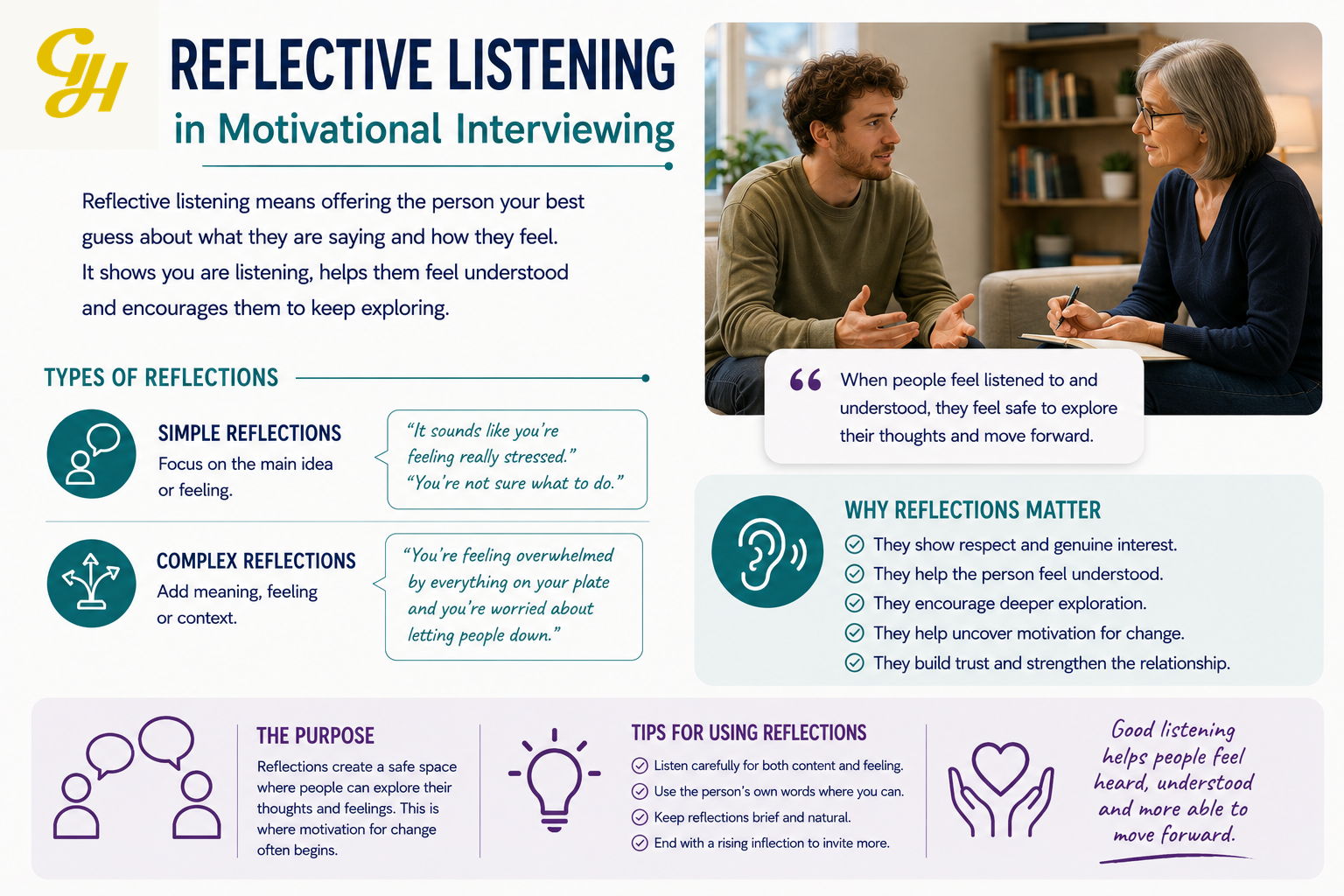
Listening is more than waiting to ask another question
Questions have an important place in MI, but a conversation dominated by questions can begin to feel like an assessment or interview. A reflection offers something different. The practitioner makes a considered statement about what they understand the person to be saying or experiencing.
A reflection is a hypothesis about meaning. The person remains free to confirm it, deepen it, correct it or take the conversation somewhere else.
Simple and complex reflections
A simple reflection stays relatively close to what has been said. A complex reflection adds possible meaning, feeling, values, strengths, emphasis or direction.
Person: “I know I should cut down, but drinking is the only time I switch off.”
Simple reflection: “Drinking helps you switch off.”
More complex reflection: “Part of you is worried about the drinking, and another part cannot yet see what would replace what it gives you.”
Complex does not necessarily mean longer or cleverer. The practitioner is listening for meaning rather than trying to impress the person with an interpretation.
Double-sided reflections and ambivalence
When someone expresses both sides of a dilemma, a double-sided reflection can acknowledge the whole picture without arguing for either side.
Person: “I know this is affecting my health, but I am not ready to stop.”
Practitioner: “You are genuinely concerned about the effect on your health, and at the same time stopping does not feel possible right now.”
The aim is not to resolve ambivalence for the person. It is to help them hear and explore it more clearly.
Why reflections matter in MI
Reflections can communicate empathy, reduce the question-and-answer rhythm, help clarify meaning and allow practitioners to respond selectively to language about change. They can also be useful when someone expresses sustain talk or when discord begins to emerge.
Reflective listening is therefore more than a technique. When a reflection fits, the person can experience being understood. When it misses, they can correct us. Either way, the conversation remains collaborative.
Reflecting change talk
Person: “I hate how tired I am every morning.”
Practitioner: “You are getting fed up with what this is costing you.”
The reflection does not add a new argument for change. It gives the person’s own motivation more room in the conversation.
Reflecting sustain talk
Person: “There is no way I’m giving it up completely.”
Practitioner: “Stopping altogether is not something you are considering right now.”
Understanding sustain talk is not agreement with it. The reflection acknowledges the person’s perspective without turning the conversation into an argument.
Questions and reflections in practice
A string of questions can keep the practitioner in control of the direction. Reflections can slow the pace and invite the person to continue in their own words.
Question-led: “How much are you drinking? How often? What problems is it causing? Have you tried to cut down?”
More reflective: “Drinking has become part of how you cope, and you are also starting to notice costs you cannot ignore.”
Developing reflective listening
A useful practice exercise is to notice how often you respond to a statement with another question. Experiment with replacing some of those questions with reflections. Then listen for what happens next.
Over time, practitioners can practise moving from repeating content towards reflecting meaning, emotion, values, strengths and motivations.
Continue exploring:
Open Questions · Change Talk · Sustain Talk · Responding to Discord
Return to MI Skills and Practice →
For further MI resources, visit the Motivational Interviewing Network of Trainers (MINT).
