
Sustain Talk in Motivational Interviewing
August 18, 2026 2026-09-22 21:12Sustain Talk in Motivational Interviewing
Sustain Talk in Motivational Interviewing
Sustain talk in Motivational Interviewing describes the person’s own language in favour of maintaining the status quo rather than moving towards change. It is a normal part of conversations about change, particularly when someone feels ambivalent.
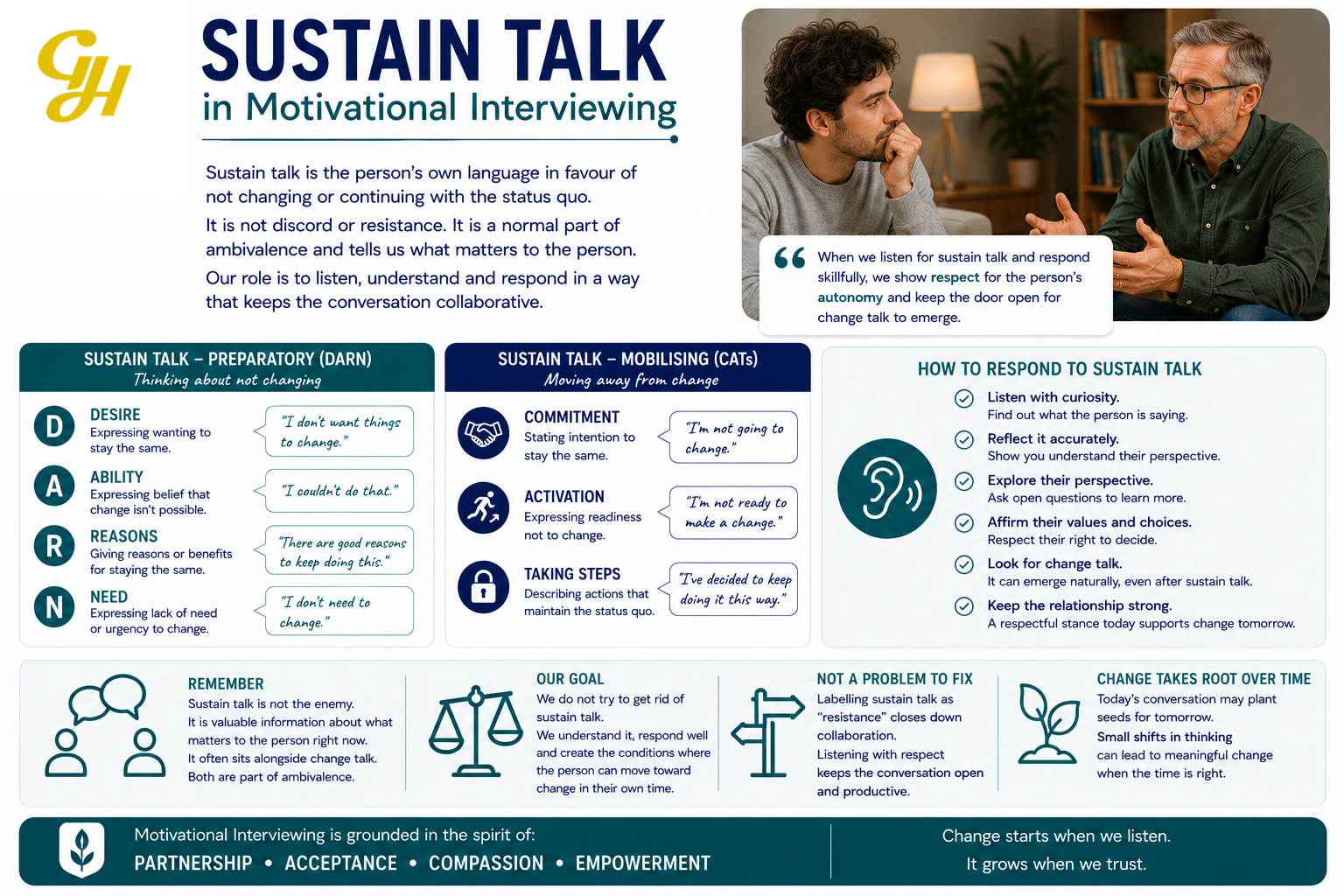
Sustain talk is not resistance, and it is not evidence that Motivational Interviewing is failing. It is language that favours the status quo in relation to a particular change goal and is a normal part of ambivalence. MI-4 continues to distinguish sustain talk from discord. Sustain talk concerns the change itself; discord signals strain or dissonance in the working relationship.
What can sustain talk sound like?
“I enjoy drinking with my friends. I don’t want to give that up.”
“I know exercise would probably help, but I’m exhausted when I get home.”
“I’ve tried to stop smoking before and it didn’t last.”
“I’m not sure things are bad enough for me to do anything yet.”
These statements favour continuing with the current situation. The practitioner’s task is not to argue against them or immediately produce the other side of the argument.
How to respond to sustain talk in Motivational Interviewing
When we hear sustain talk, the temptation can be to correct it, challenge it or offer reasons why the person should change. This can invite the person to defend the status quo more strongly.
Instead, MI practitioners listen carefully and respond in ways that demonstrate understanding while keeping the conversation open.
Person: “I know my drinking causes problems, but it’s how I switch off after work.”
Simple reflection: “Drinking helps you unwind.”
Complex reflection: “Part of you is wondering how you would cope with the pressure of work without it.”
Neither reflection agrees or disagrees with the person. Instead, each communicates understanding and creates space for further exploration.
Change talk and sustain talk can coexist
Ambivalence often means that people express both change talk and sustain talk, sometimes within the same sentence.
Person: “I know I need to cut down, but drinking is the only thing that helps me relax.”
“I know I need to cut down” favours change. “Drinking is the only thing that helps me relax” favours maintaining the status quo.
The aim is not to eliminate sustain talk. MI-4 describes the practitioner task as softening sustain talk rather than confronting or defeating it. Instead, practitioners listen for both sides of the person’s ambivalence and respond without turning the conversation into an argument for change.
Change talk points towards change. Sustain talk points towards maintaining the current situation. Both belong to the person.
Avoid arguing against sustain talk
When practitioners hear reasons for not changing, it can be tempting to respond with the opposite argument. The stronger we argue for change, however, the more likely the person may be to explain why change is difficult, unnecessary or unwanted.
This is one way the Fixing Reflex can shape a conversation.
Rather than trying to defeat sustain talk, MI practitioners can reflect it, explore it and remain curious about the person’s perspective. This helps maintain partnership while leaving room for the person’s own motivations for change to emerge.
Responding without reinforcing sustain talk
Listening carefully to sustain talk does not mean repeatedly inviting the person to explain why they should not change. Too much attention to sustain talk can unintentionally encourage further arguments for maintaining the status quo.
Practitioners can acknowledge what has been said and then gently broaden the conversation.
Person: “I’ve tried to lose weight before and it never lasts.”
Reflection: “You’ve put a lot of effort into this before and ended up disappointed.”
Possible follow-up: “What, if anything, might need to be different this time?”
The first response communicates understanding. The follow-up creates an opportunity for the person to consider possibilities without dismissing their experience or pushing them towards change.
Developing skills for responding to sustain talk
Becoming skilful with sustain talk involves learning to notice your own reactions as well as listening carefully to the person.
In practice, it can help to ask yourself:
- Am I becoming uncomfortable because the person is not moving towards the outcome I hope for?
- Am I beginning to persuade, correct or argue for change?
- Have I accurately understood what matters to this person?
- Could a reflection be more useful than another question?
- Is there change talk that I could invite the person to explore further?
The aim is not to make sustain talk disappear. It is to respond in ways that preserve Partnership, Acceptance, Compassion and Empowerment, while creating space for the person to explore their own motivations and choices.
Continue exploring
Change Talk in Motivational Interviewing →
Working with Ambivalence in Motivational Interviewing →
The Fixing Reflex in Motivational Interviewing →
MI Skills and Practice →
For further information about Motivational Interviewing, visit the Motivational Interviewing Network of Trainers (MINT).
