
Open Questions in Motivational Interviewing
August 12, 2026 2026-09-22 20:40Open Questions in Motivational Interviewing
Open Questions in Motivational Interviewing
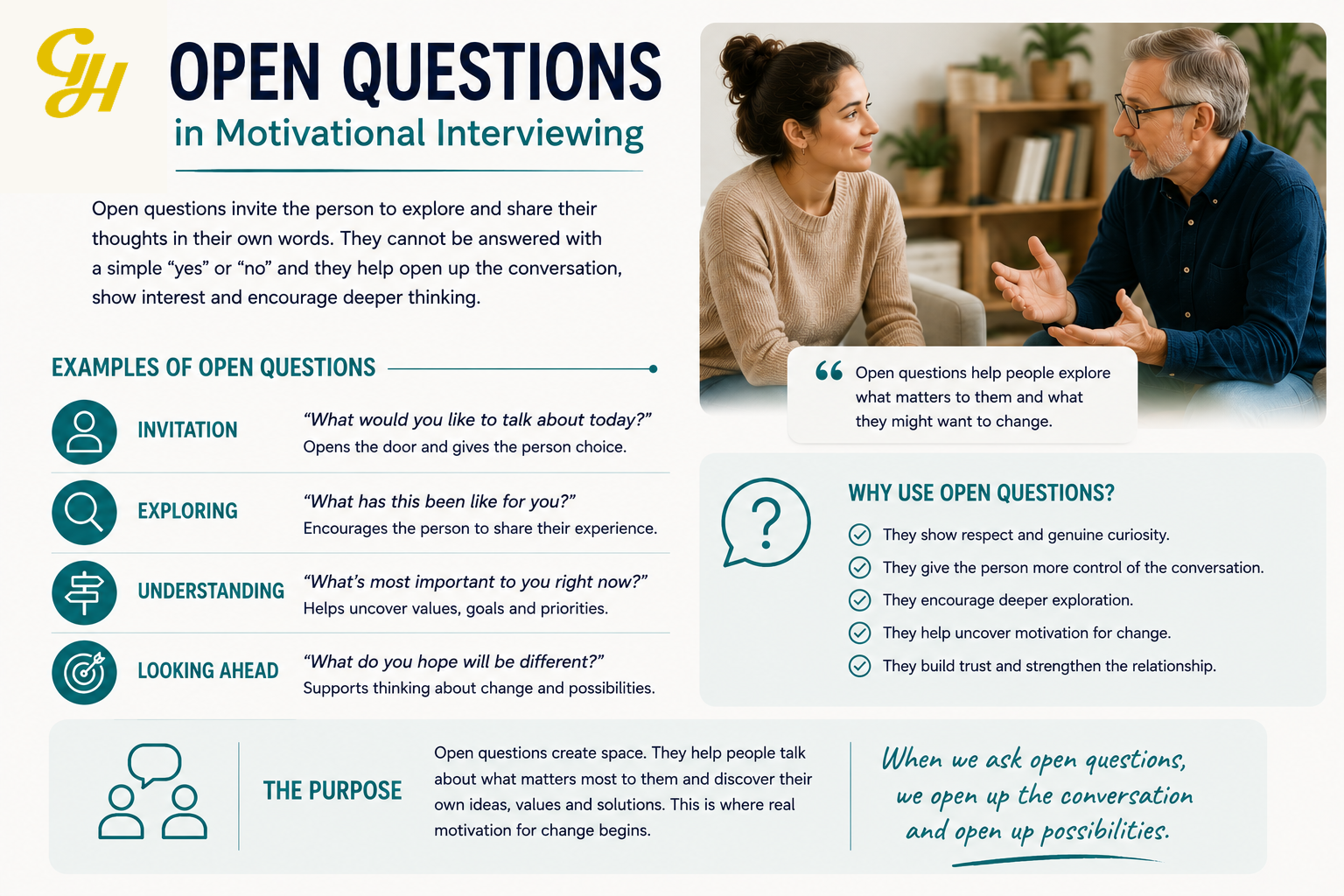
Open questions in Motivational Interviewing invite people to think, explore and elaborate. They are used purposefully, not simply to collect information.
Questions shape conversations
“Did you take your medication?” and “How have you been getting on with your medication?” may concern the same topic, but they create different opportunities for response.
Open questions can invite experience, meaning, values, concerns, strengths and ideas. They can also create opportunities for people to voice their own reasons and motivations for change.
Open does not automatically mean MI-consistent
A question can be grammatically open while still feeling like an interrogation or an attempt to lead someone towards the answer we want. Tone, timing, intention and what we do with the answer all matter.
Useful possibilities:
“What concerns you most about this?”
“What would you like to be different?”
“What has helped when you have made difficult changes before?”
“Where does this leave you now?”
Directional questions
In MI, questions can be directional as well as open. A directional question intentionally invites the person to explore a particular aspect of change, such as their reasons, hopes, abilities or concerns, while leaving them free to decide what the answer means for them.
Direction is not the same as steering someone towards a predetermined answer. The practitioner remains curious and responsive to what the person actually says. Questions such as “What might be some advantages of making this change?” or “If you did decide to make a change, how might you go about it?” can create opportunities for people to explore and voice their own motivations for change without requiring or manufacturing a particular answer.
Questions and reflections
One of the common challenges for practitioners learning MI is asking too many questions. Reflective listening can reduce the question-and-answer rhythm and allow a conversation to deepen.
The aim is not to eliminate questions. It is to use them alongside affirmations, reflections, summaries and information exchange in a flowing conversation.
Continue exploring
Return to MI Skills & Practice →
The Motivational Interviewing Network of Trainers (MINT) provides further information and resources about Motivational Interviewing.
