
Discord in Motivational Interviewing
August 18, 2026 2026-09-22 21:10Discord in Motivational Interviewing
Discord in Motivational Interviewing
Discord in Motivational Interviewing describes tension or difficulty in the working relationship between the practitioner and the person. It can appear when someone feels unheard, judged, pushed or misunderstood.
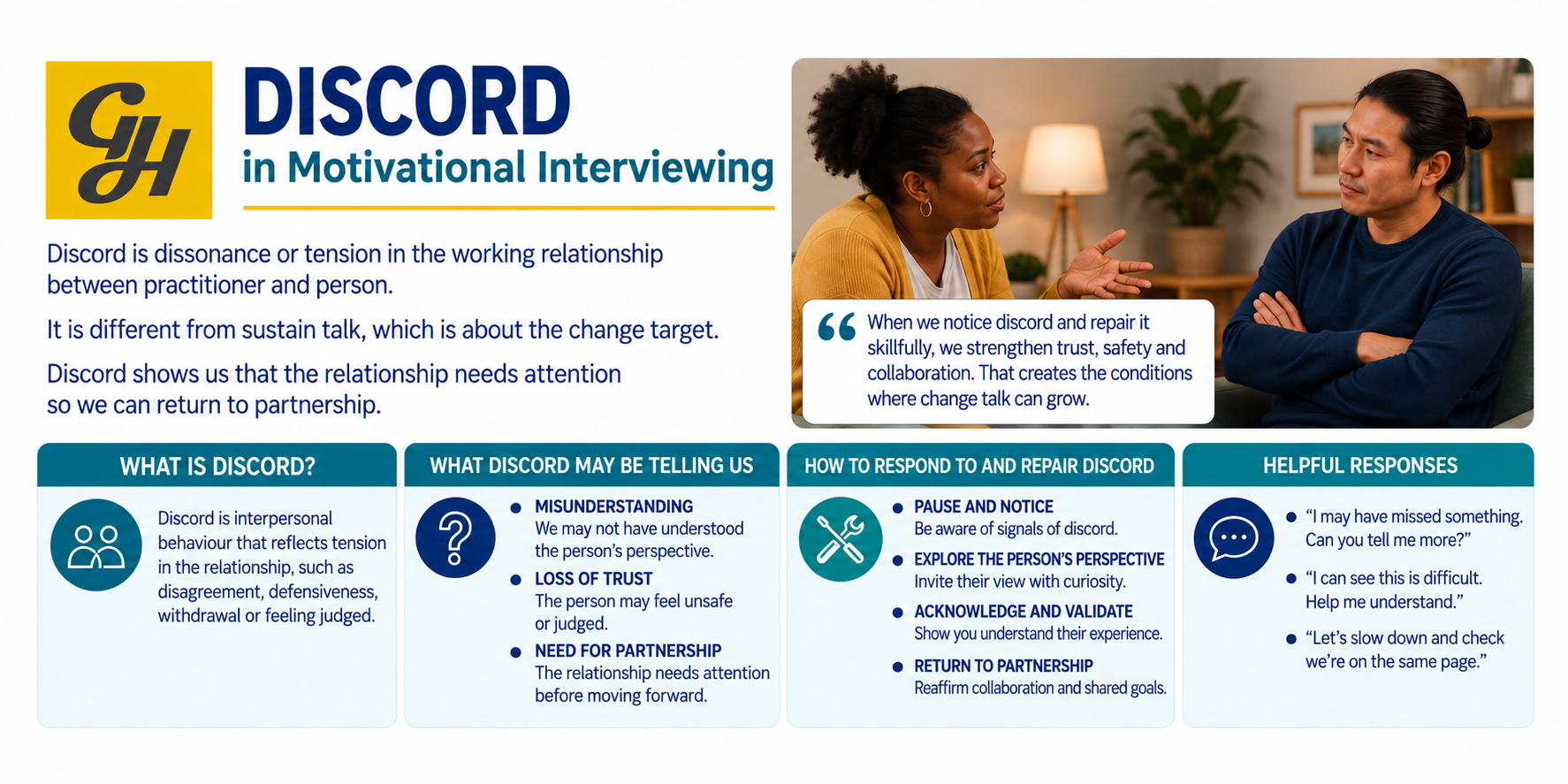
Discord is different from sustain talk. Sustain talk concerns the person’s arguments for maintaining the status quo, while discord tells us something about what is happening between the people in the conversation.
In Motivational Interviewing, discord is not viewed as a characteristic of the person. Rather than labelling someone as “resistant”, we pay attention to the interaction and consider how our own approach may be contributing to the difficulty.
Recognising discord early gives us an opportunity to reduce pressure, restore partnership and return to a more collaborative conversation.
What does discord sound like in Motivational Interviewing?
Discord can show itself through arguing, interrupting, discounting, disengaging or challenging the direction of the conversation. In MI these interpersonal signals have sometimes been described as ‘smoke alarms’ in the working alliance: cues that the relationship or our approach may need attention. Sometimes discord is obvious; at other times it appears through shorter answers, withdrawal or a change in the person’s tone.
For example:
“You’re not listening to what I’m saying.”
“You’ve already decided what you think I should do.”
“Why do you keep asking me about this?”
“You don’t understand what it’s like for me.”
These responses can provide useful information about the interaction. Rather than asking, “Why is this person being resistant?”, an MI practitioner can ask:
“What is happening between us, and what might I do differently?”
This shift matters. It moves us away from locating the problem within the person and towards taking responsibility for our contribution to the conversation.
Discord is not the same as sustain talk
Sustain talk and discord can sometimes occur together, but they describe different aspects of a Motivational Interviewing conversation.
Sustain talk is about the change. The person expresses reasons for maintaining the status quo, concerns about changing or arguments against change.
“I enjoy smoking and I’m not sure I want to stop.”
Discord is about the relationship or interaction. The person signals tension, disagreement or disconnection with the practitioner.
“You keep trying to tell me what to do.”
This distinction matters because our response will differ. Sustain talk invites us to listen carefully to the person’s ambivalence. Discord invites us to pay particular attention to the working relationship and consider whether we need to change our approach.
A person can express strong sustain talk while remaining engaged and collaborative. Equally, discord can arise even when someone wants to make a change.
Recognising the difference helps us respond to what is actually happening rather than treating every difficult moment as “resistance”.
What can contribute to discord in Motivational Interviewing?
Discord can emerge for many reasons. Sometimes the practitioner may be moving faster towards change than the person is ready or willing to move. At other times, the person may feel that their perspective, priorities or autonomy are not being fully respected.
Practitioner behaviours that can contribute to discord include:
- arguing for change
- confronting or correcting
- giving advice without permission or sufficient understanding
- asking too many questions without reflecting
- directing the conversation towards our priorities rather than the person’s
- overlooking or minimising the person’s concerns
- moving prematurely towards planning
- adopting an expert position when collaboration would be more helpful
The fixing reflex can play an important part. When we become concerned about someone’s choices, it is natural to want to persuade them towards what we believe would help. Yet the harder we push, the more likely the person may feel the need to defend their autonomy or perspective.
Discord therefore offers useful feedback. It can invite the practitioner to consider:
“What am I doing that might be making it harder for this person to feel heard, understood or free to choose?”
The purpose is not to blame the practitioner whenever discord occurs. It is to recognise that the interaction can change, and that we have an opportunity to adjust our approach.
How to respond to discord in Motivational Interviewing
When discord appears, continuing to push in the same direction is unlikely to help. Instead, it can be useful to slow the conversation down and attend to the working relationship.
Helpful responses include:
Reflect what you are hearing
A reflection can demonstrate that you are listening rather than preparing another argument.
“It feels as though I’ve been pushing this harder than you wanted.”
Apologise when appropriate
A straightforward apology can help restore collaboration.
“I’m sorry. I moved too quickly there.”
Affirm autonomy
Make it clear that the person retains choice and control.
“You’re the one who decides what, if anything, you want to do.”
Shift focus
Sometimes the direction of the conversation needs to change.
“Perhaps we’ve been concentrating on something that isn’t your priority right now.”
Come alongside
Rather than continuing to argue for change, acknowledge the person’s position and reduce pressure.
“There are some important reasons why you’re not ready to make this change.”
The aim is not to use a technique to make discord disappear. It is to restore partnership and understanding. Our response should communicate that we are willing to listen, adjust our approach and respect the person’s autonomy.
Authority does not remove the need for partnership
Discord can be particularly important in healthcare, social work, criminal justice and other settings where practitioners hold professional or statutory responsibilities. Motivational Interviewing does not require practitioners to hide or minimise those responsibilities.
Being clear about what is negotiable, what is not, and where the person still has choice can support a more honest partnership. Even when some decisions or boundaries are fixed, we can remain curious about the person’s perspective and respect their autonomy wherever choice remains.
Why Motivational Interviewing moved away from “resistance”
Earlier descriptions of Motivational Interviewing often used the term resistance. Contemporary MI makes a more useful distinction between sustain talk and discord.
You can learn more about Motivational Interviewing and the international MI community through the Motivational Interviewing Network of Trainers (MINT).
Calling someone “resistant” can imply that the difficulty belongs to the person. It can encourage us to see them as unmotivated, difficult or unwilling to cooperate.
The concept of discord shifts our attention towards the interaction. If tension develops, we can become curious about what is happening between us rather than assigning a label to the person.
This changes the questions we ask ourselves. Instead of:
“Why is this person resisting?”
we might ask:
“What is happening in our conversation that is creating discord?”
or:
“How could I respond differently to restore partnership?”
This perspective fits closely with the Spirit of Motivational Interviewing. Partnership, acceptance, compassion and empowerment invite us to work with people rather than trying to overcome opposition.
Discord therefore becomes useful information. It signals that something in the interaction may need attention and gives us an opportunity to listen differently, reduce pressure and reconnect.
Noticing discord in our own practice
Discord is not only something we hear in another person’s words. We may also notice changes in ourselves that suggest the conversation is becoming less collaborative.
We might notice that we are:
- talking more and listening less
- becoming frustrated or impatient
- repeating the same argument in different ways
- trying harder to convince the person
- asking questions primarily to lead them towards our preferred answer
- feeling responsible for making the person change
- becoming less curious about their perspective
Noticing these signs gives us an opportunity to pause, become curious and reconsider our approach.
A useful question is:
“Am I working with this person, or am I beginning to work on them?”
Recognising our own contribution does not mean taking responsibility for everything that happens in the conversation. It means remaining attentive to the relationship and recognising what we can change: our own response.
Developing this awareness can help us notice the fixing reflex earlier, return to reflective listening and reconnect with the Spirit of Motivational Interviewing.
Developing your response to discord
Responding skilfully to discord takes practice. Often the challenge is noticing it early enough to change direction before the conversation becomes increasingly strained.
Reflective listening is particularly valuable. A well-judged reflection can communicate understanding, reduce the need for the person to defend their perspective and help restore collaboration.
It can also help to become curious about our own contribution. Notice when the fixing reflex appears, when you begin working harder for change than the person, or when your agenda starts taking priority over theirs.
As you develop your MI practice, consider:
- What are the early signs that discord is developing?
- What happens in me when someone disagrees with or challenges me?
- Do I become more persuasive when the conversation becomes difficult?
- Can I acknowledge my contribution and change direction?
- Am I continuing to communicate partnership, acceptance, compassion and empowerment?
The aim is not to conduct conversations in which discord never occurs. It is to become increasingly able to recognise discord, respond flexibly and restore partnership when the working relationship becomes strained.
