
Understanding Motivational Interviewing
Engaging in Motivational Interviewing
Engaging in Motivational Interviewing is the process of establishing a helpful working relationship. It is the foundation for everything that follows in MI because people are more likely to explore difficult issues when they experience the conversation as respectful, collaborative and genuinely attentive to what matters to them.
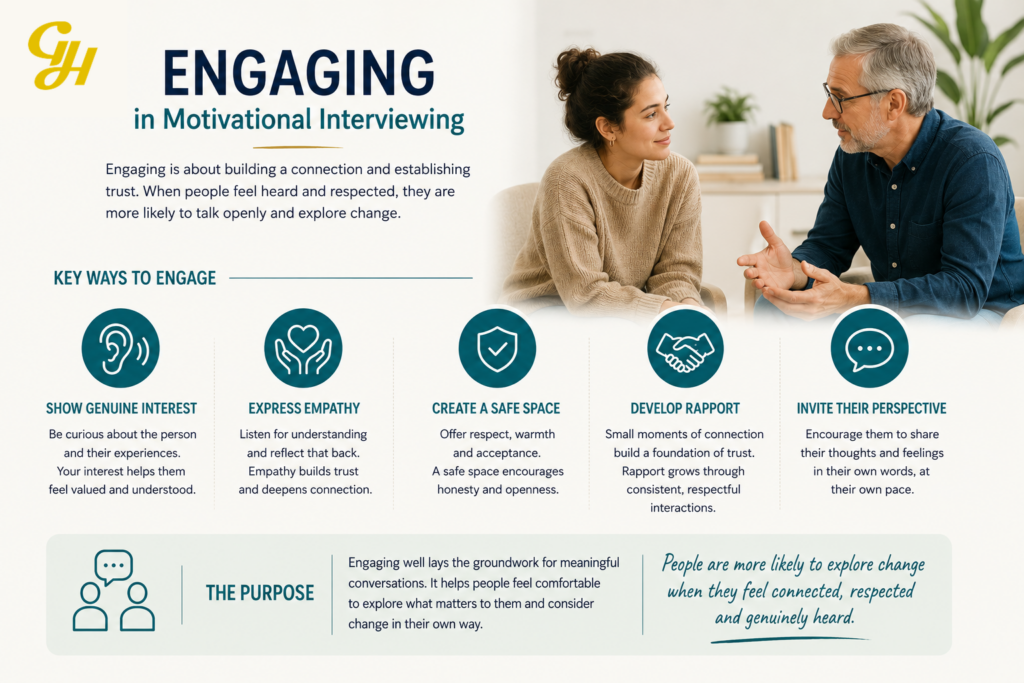
Engaging is not simply the opening few minutes of a conversation. The quality of engagement can strengthen or weaken throughout an interaction, so practitioners continue to attend to the relationship while they focus, evoke and plan.
What does engaging mean in MI?
Engaging involves developing a mutually trusting and respectful connection in which practitioner and person can work together. The practitioner seeks to understand the person’s perspective rather than immediately trying to correct, persuade or direct them.
This does not require agreement with everything the person says. It requires listening carefully enough that the person experiences their perspective as heard and taken seriously.
Explore the Four Tasks of Motivational Interviewing →
The relationship is part of the method
In Motivational Interviewing, relationship quality is not separate from the method. Empathy, acceptance, partnership, compassion and empowerment influence how the practitioner listens and responds.
When people experience judgement, pressure or a lack of understanding, they may become guarded or defensive. A strong working relationship creates greater freedom to explore uncertainty, concerns and possible change honestly.
Explore the Spirit of Motivational Interviewing →
Listening before trying to help
A common challenge for helping professionals is the urge to solve the problem quickly. Expertise can make it tempting to offer advice before fully understanding the person’s experience.
Engaging asks practitioners to slow this impulse. Reflective listening, open questions and affirmations help build understanding before the conversation moves towards solutions. This can reduce the fixing reflex and make later guidance more relevant.
Explore the Fixing Reflex in Motivational Interviewing →
Explore Reflective Listening in Motivational Interviewing →
Four questions about engagement
Practitioners can consider several questions when reflecting on engagement: How comfortable is this person talking with me? How supportive and helpful am I being? Do I understand the person’s perspective and concerns? Are we working together as partners?
These questions shift attention away from simply completing an assessment or delivering information and towards the quality of the interaction itself.
Engagement and discord
Discord can be a useful signal that engagement has weakened. Arguing, interrupting, disengaging or defending may indicate tension in the working relationship rather than a fixed characteristic of the person.
Instead of labelling someone as resistant, an MI practitioner considers what is happening between practitioner and person and how their own behaviour may be contributing. Slowing down, reflecting, apologising where appropriate or emphasising autonomy can help restore collaboration.
Explore Discord in Motivational Interviewing →
Engaging does not mean avoiding direction
A good relationship alone is not Motivational Interviewing. MI is a guiding style, and conversations often have a particular change focus. Engaging provides the relational foundation from which practitioner and person can agree what to focus on and explore motivation.
The practitioner can therefore be purposeful without becoming controlling. The aim is to work with the person rather than doing MI to them.
Skills that support engagement
Core MI communication skills support engagement. Open questions invite the person’s perspective. Affirmations recognise strengths and efforts. Reflections communicate understanding and encourage exploration. Summaries gather important themes and show that the practitioner has been listening.
Information and advice can also support engagement when exchanged collaboratively and with attention to what the person already knows, wants and needs.
Explore OARS + I: Core Motivational Interviewing Skills →
When engagement needs attention
Practitioners may need to return explicitly to engaging when the conversation becomes strained, the focus changes, difficult information emerges or the person appears less involved. This is one reason the four tasks should not be understood as a rigid sequence.
Engaging remains relevant throughout the conversation. Without sufficient engagement, attempts to evoke motivation or develop a plan may feel premature or imposed.
Developing your engaging skills
Developing your skills in Engaging in Motivational Interviewing involves paying attention not only to what you say but also to how the other person responds. Useful reflection questions include whether the practitioner listened more than they explained, whether reflections outnumbered questions, whether autonomy was respected and whether the person had enough space to express what mattered to them.
Feedback, recorded practice and coaching can help practitioners notice interaction patterns that are difficult to recognise while conducting a conversation.
Explore How Motivational Interviewing Works →
For further MI resources, visit the Motivational Interviewing Network of Trainers (MINT).
← The Four Tasks of Motivational Interviewing | Focusing in Motivational Interviewing →
