
The Four Tasks of Motivational Interviewing
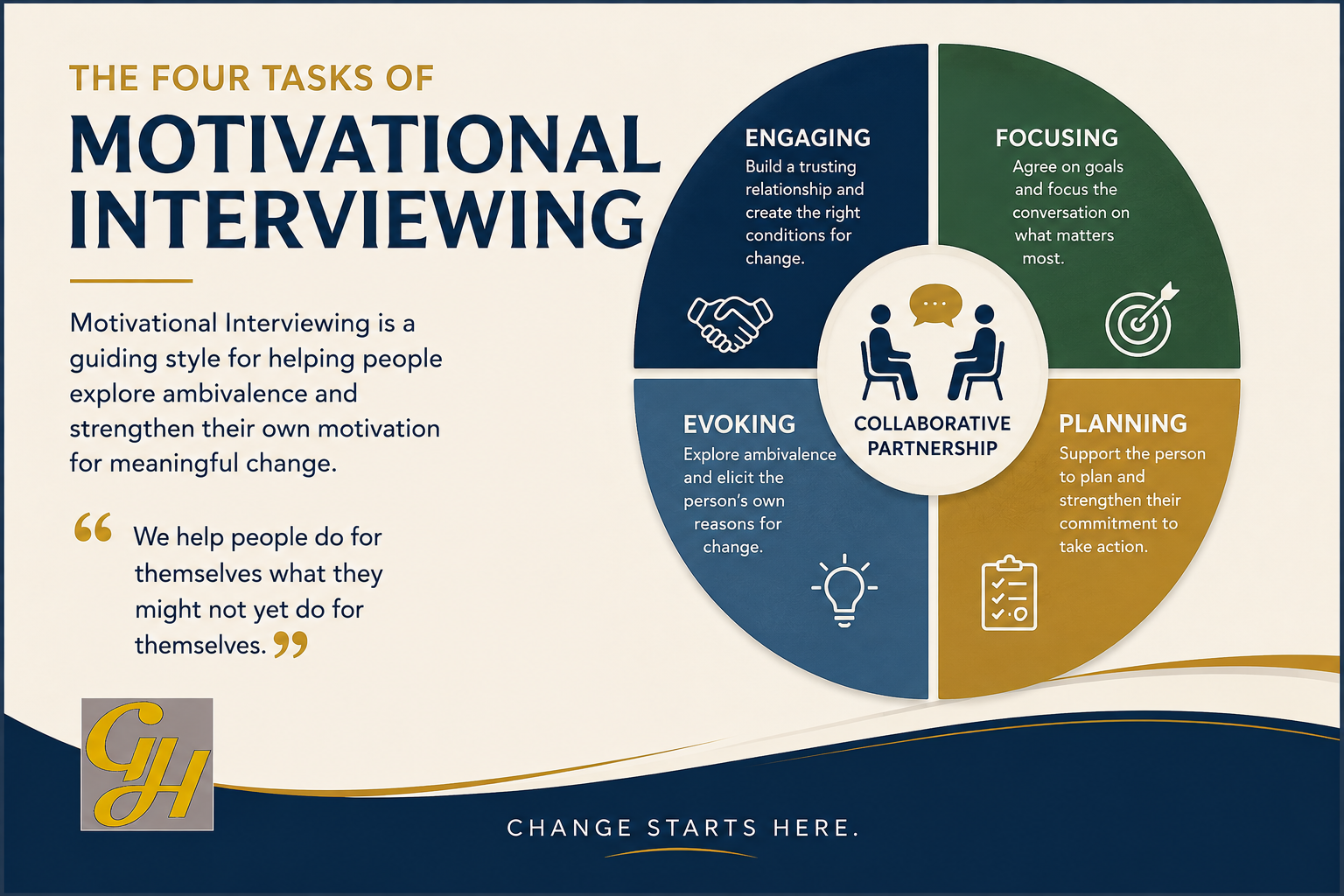
The Four Tasks of Motivational Interviewing are Engaging, Focusing, Evoking and Planning. These overlapping tasks help practitioners guide conversations about change. They are not four rigid stages to complete in order. In real conversations, practitioners often move back and forth between them as the conversation develops.
The tasks describe what the conversation is doing. They are different from the MI Spirit, which describes how we are with people: Partnership, Acceptance, Compassion and Empowerment.
1. Engaging in Motivational Interviewing
Engaging is about establishing a useful working relationship. Before a conversation can become meaningfully directional, the person needs enough space to feel heard, understood and respected.
Reflective listening is central here. Open questions, affirmations and summaries can also help, but engagement is not simply a set of techniques. The question is whether the interaction is creating enough trust and partnership for the person to speak openly.
2. Focusing
Focusing is the process of developing and maintaining a clear direction for the conversation. Sometimes the focus is obvious. At other times the practitioner and the person may have several concerns, priorities or possible directions.
Focusing in MI is collaborative. Professional responsibilities still matter, but the practitioner avoids quietly imposing an agenda while appearing to offer choice.
A useful question is: What change, if any, are we talking about together?
3. Evoking
Evoking is the task of exploring the person’s own motivations for change. It involves listening carefully for change talk, responding in ways that help the person elaborate their own reasons, hopes, needs, abilities and intentions, and making room for sustain talk rather than arguing against it.
Evoking is not about manufacturing change talk or persuading someone to say what the practitioner wants to hear. It is about creating conditions in which the person can hear and examine their own motivations.
4. Planning in the Four Tasks of Motivational Interviewing
Planning becomes relevant when there is enough readiness to consider what happens next. It is not automatically the final step of every MI conversation.
Planning can involve strengthening commitment, developing a specific next step, considering possible barriers and drawing on the person’s own ideas and resources. The plan should remain owned by the person rather than becoming the practitioner’s solution.
The tasks overlap
A conversation may begin with engagement, move towards a focus, then return to engagement if tension appears. Planning may reveal uncertainty that takes the conversation back into evoking. A change in circumstances may require the focus to be reconsidered.
This flexibility matters. Treating the four tasks as a script can make MI mechanical. The practitioner needs to stay responsive to what is happening in the relationship and conversation.
Spirit and tasks are not the same thing
The distinction is important. Evoking is one of the four tasks. Empowerment is part of the MI Spirit.
The current MI Spirit is:
Partnership · Acceptance · Compassion · Empowerment
The four tasks are:
Engaging · Focusing · Evoking · Planning
Start with Engaging in Motivational Interviewing →
Explore the Spirit of Motivational Interviewing →
For further information about Motivational Interviewing and the international MI community, visit the Motivational Interviewing Network of Trainers (MINT).
