
The Fixing Reflex in Motivational Interviewing
August 12, 2026 2026-09-22 20:37The Fixing Reflex in Motivational Interviewing
The Fixing Reflex in Motivational Interviewing
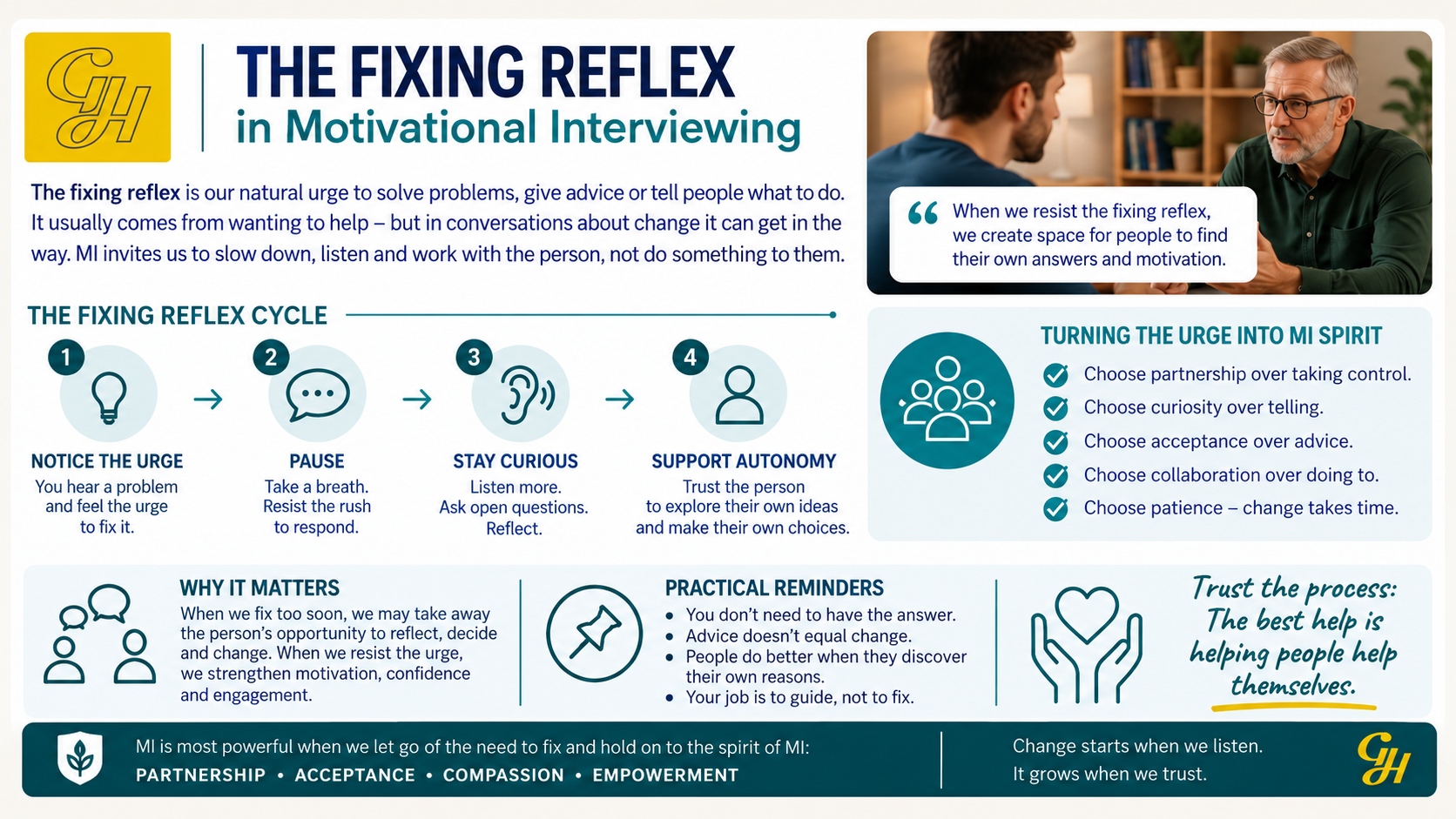
The fixing reflex in Motivational Interviewing is our natural desire to put things right when we see someone making choices that may cause them difficulty. Earlier MI literature commonly described this as the righting reflex. The idea is the same: a well-intentioned urge to correct, persuade, advise or solve the problem for the person. Learning to recognise and manage this impulse can help us avoid persuasion and instead create space for people to explore their own reasons for change.
What is the Fixing Reflex in Motivational Interviewing?
The fixing reflex in Motivational Interviewing is our natural desire to put things right when we see someone making choices that may cause them difficulty. It often comes from a genuine wish to help, particularly when we can see the risks of continuing with a particular behaviour.
The difficulty is that when we argue strongly for change, the other person may begin to argue for the opposite. They may explain why change is difficult, defend their current behaviour or tell us why our suggestions will not work.
Motivational Interviewing invites practitioners to notice the fixing reflex and resist the urge to immediately provide the answer. Instead, we listen carefully and help the person explore their own motivations, concerns and ideas about change.
Why can the Fixing Reflex in Motivational Interviewing be unhelpful?
When people feel that they are being persuaded, corrected or told what they should do, they may naturally defend their current position. The conversation can begin to feel like a debate, with the practitioner arguing for change and the person explaining why change cannot or should not happen.
In Motivational Interviewing, we want to avoid getting caught on opposite sides of an argument. Rather than trying to make the case for change ourselves, we create opportunities for the person to voice their own reasons, desires, abilities and need for change.
Managing the fixing reflex does not mean withholding useful knowledge or never offering advice. It means paying attention to how and when we offer information, while maintaining partnership and supporting the person’s autonomy.
What does the fixing reflex sound like?
The fixing reflex can appear in quite ordinary and well-intentioned responses. We may hear ourselves saying:
“You really need to stop doing this.”
“Have you thought about trying…?”
“If you carry on like this, you’re going to make things worse.”
“What you should do is…”
“But surely you can see that changing would be better for you?”
None of these responses necessarily comes from a bad intention. Often they reflect genuine concern and a desire to help.
A useful clue is to notice who is making the argument for change. If the practitioner is doing most of the explaining, persuading or problem-solving while the person is describing why change is difficult, the fixing reflex may have taken over the conversation.
A helpful question to ask ourselves is:
“Am I working harder for this person’s change than they are?”
The fixing reflex and ambivalence
The fixing reflex becomes particularly important when someone feels ambivalent about change. They may already be aware of the reasons for changing while also having important reasons for maintaining the status quo.
If we respond by taking the side of change, the person may naturally begin to voice the other side of their ambivalence. The practitioner ends up producing the arguments for change while the person produces more sustain talk.
For example:
Practitioner: “You really need to cut down your drinking. It’s affecting your health.”
Person: “I know, but having a drink is one of the few things that helps me relax.”
The practitioner’s intention is helpful, but the interaction invites the person to defend the current behaviour.
An MI-consistent response might instead explore the person’s perspective:
Practitioner: “There are things you enjoy about drinking, and you’re also beginning to wonder about the effect it’s having on your health.”
This creates space for both sides of the ambivalence without requiring the practitioner to argue for change.
Managing the fixing reflex in practice
Managing the fixing reflex does not mean trying to eliminate it. The impulse to help, advise or solve problems is human and often reflects genuine care. The skill lies in noticing the impulse before automatically acting on it.
Some useful practices include:
- Pause before offering a solution. Ask yourself whether the person needs information or whether they first need to feel understood.
- Use reflective listening. Reflecting what you hear can deepen exploration without immediately directing the conversation.
- Ask rather than assume. Invite the person’s ideas about what might help before offering your own.
- Listen for change talk. Pay attention to the person’s own reasons, desire, ability, need and commitment to change.
- Respect autonomy. Remember that the decision about whether and how to change belongs to the person.
- Exchange information collaboratively. When information or advice would be useful, seek permission and explore what the person makes of it rather than simply telling them what to do.
A useful question to carry into practice is:
“Before I offer my answer, what might I learn by listening a little longer?”
Managing the fixing reflex therefore does not make the practitioner less helpful. It can help us become more responsive to what the person actually needs from the conversation.
The fixing reflex and the Spirit of Motivational Interviewing
Managing the fixing reflex is closely connected to the Spirit of Motivational Interviewing: Partnership, Acceptance, Compassion and Empowerment.
Partnership reminds us that change is a collaborative process rather than something we do to another person.
Acceptance includes respecting the person’s autonomy and recognising their right to make their own choices.
Compassion keeps our attention on the person’s needs and wellbeing rather than on our need to be right or achieve a particular outcome.
Empowerment encourages us to recognise and strengthen the person’s own capabilities, ideas and resources for change.
The fixing reflex can pull us away from these qualities, even when our intentions are good. Becoming aware of it helps us return to a way of working that supports people to think, explore and decide for themselves.
The question is not simply, “How can I convince this person to change?” but “How can I help create a conversation in which they can explore change for themselves?”
Developing awareness of your fixing reflex
Becoming more aware of the fixing reflex takes practice. It often appears most strongly when we care about the outcome, feel responsible for helping, or believe we can see a solution that the other person cannot yet see.
As you develop your Motivational Interviewing practice, notice:
- When am I most likely to start persuading?
- What happens when someone does not take my advice?
- Do I become more directive when I feel worried about someone?
- Can I tolerate uncertainty without immediately trying to solve it?
- Am I listening for the person’s ideas before offering my own?
- Is my response consistent with partnership, acceptance, compassion and empowerment?
The aim is not to become a passive practitioner. Motivational Interviewing can include information, advice and professional expertise. The difference lies in how we offer that expertise and how much space remains for the person’s own knowledge, values and autonomy.
