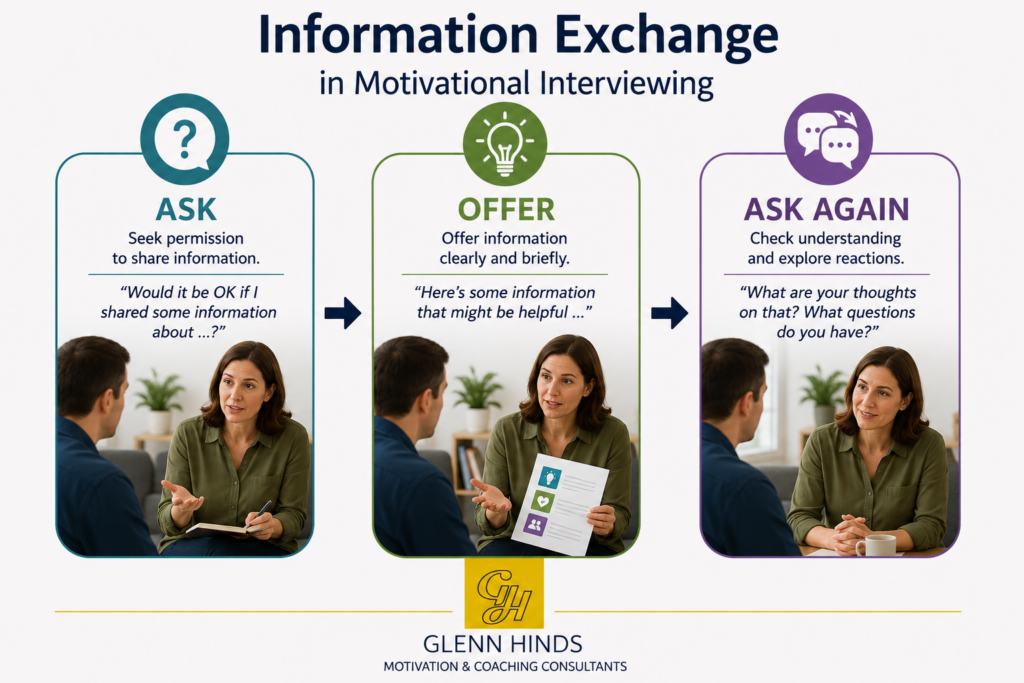
Information Exchange in Motivational Interviewing

Information Exchange in Motivational Interviewing

Information exchange in Motivational Interviewing is more than giving advice or telling someone what they should do. It is a collaborative way of sharing knowledge, concerns and options while respecting the person’s expertise, choice and autonomy.

In many professional conversations, sharing information is necessary. MI asks us to pay attention not only to what we offer, but how that information enters the conversation.

The + I in OARS + I

The fourth edition of Motivational Interviewing describes the core communication skills as OARS + I: Open Questions, Affirmations, Reflections, Summaries and Information Exchange.

The + I makes explicit something practitioners have always needed to navigate. We may hold knowledge about treatment, risk, legislation, services or evidence. The other person brings knowledge of their own life, values, priorities and what is likely to be workable. Information exchange recognises both forms of expertise.

The aim is not to choose between professional expertise and autonomy. It is to bring both into the same conversation.

Explore OARS + I: Core Motivational Interviewing Skills →

Ask-Offer-Ask: a practical framework

Ask-Offer-Ask provides a simple structure for exchanging information while keeping the other person involved. Earlier editions of MI used the term Elicit-Provide-Elicit. In the fourth edition, Miller and Rollnick use the more everyday language of Ask-Offer-Ask. The underlying purpose remains similar.

Ask-Offer-Ask information exchange in Motivational Interviewing

1. Ask

Find out what the person already knows, what they would like to know, or whether they are interested in hearing information from you.

“What have you heard about how alcohol can affect sleep?”

2. Offer

With permission where appropriate, offer information clearly and in manageable amounts. Avoid presenting it as a verdict. Where possible, offer options rather than a single instruction.

“Would it be OK if I shared what we know about that?”

3. Ask again

Return the conversation to the person. Ask what they make of the information, what stands out, or how it fits with their experience.

“What do you make of that?”

This final Ask matters. Without it, Ask-Offer-Ask can easily become Ask-Offer followed by the practitioner continuing to talk. The second Ask restores collaboration and gives the person space to interpret the information for themselves.

Permission, autonomy and professional responsibility

Seeking permission does not mean practitioners must avoid important or difficult information. In health, social care, education and criminal justice settings there are times when we have a responsibility to explain risk, legal requirements, professional concerns or available choices.

Where permission is genuinely available, asking can support collaboration. Where professional responsibility requires information to be shared, we should not pretend the person has a choice about whether they hear it. We can still be transparent about why we are raising the issue, keep the information concise and return to their perspective afterwards.

For example:

“I need to be clear with you about something from a safeguarding point of view.”

“There are a couple of risks I think it is important you know about. Then I would really like to hear what you make of them.”

Clarity and compassion can coexist. MI does not ask practitioners to abandon expertise. It asks us to combine expertise with partnership.

Common traps when giving information

Information exchange can drift away from MI when we:

  • give more information than the person wants or can use;
  • assume that information alone will create motivation;
  • correct the person before understanding their perspective;
  • use expertise to win an argument;
  • offer solutions before exploring the person’s own ideas;
  • ask permission and then deliver a long lecture;
  • continue giving advice after the person has rejected it.

These responses can activate the fixing reflex. A useful discipline is to offer less, listen more and pay close attention to the person’s response.

Practising Information Exchange in Motivational Interviewing

A useful practice exercise is to notice what happens when you feel the urge to explain, advise or correct. Before offering information, consider:

  • What does this person already know?
  • What information would actually be useful now?
  • Have I understood their perspective first?
  • Can I offer this briefly and neutrally?
  • How will I invite their response afterwards?

The aim is not to follow Ask-Offer-Ask mechanically. It is to develop a conversational habit in which information moves in both directions.

Return to MI Skills and Practice →

Develop your Motivational Interviewing skills

Information exchange becomes more skilful when it sits alongside careful listening, reflections and respect for autonomy. Explore the wider Knowledge Centre or develop these skills through experiential MI training.