
Summaries in Motivational Interviewing
August 12, 2026 2026-09-22 20:47Summaries in Motivational Interviewing
Summaries in Motivational Interviewing
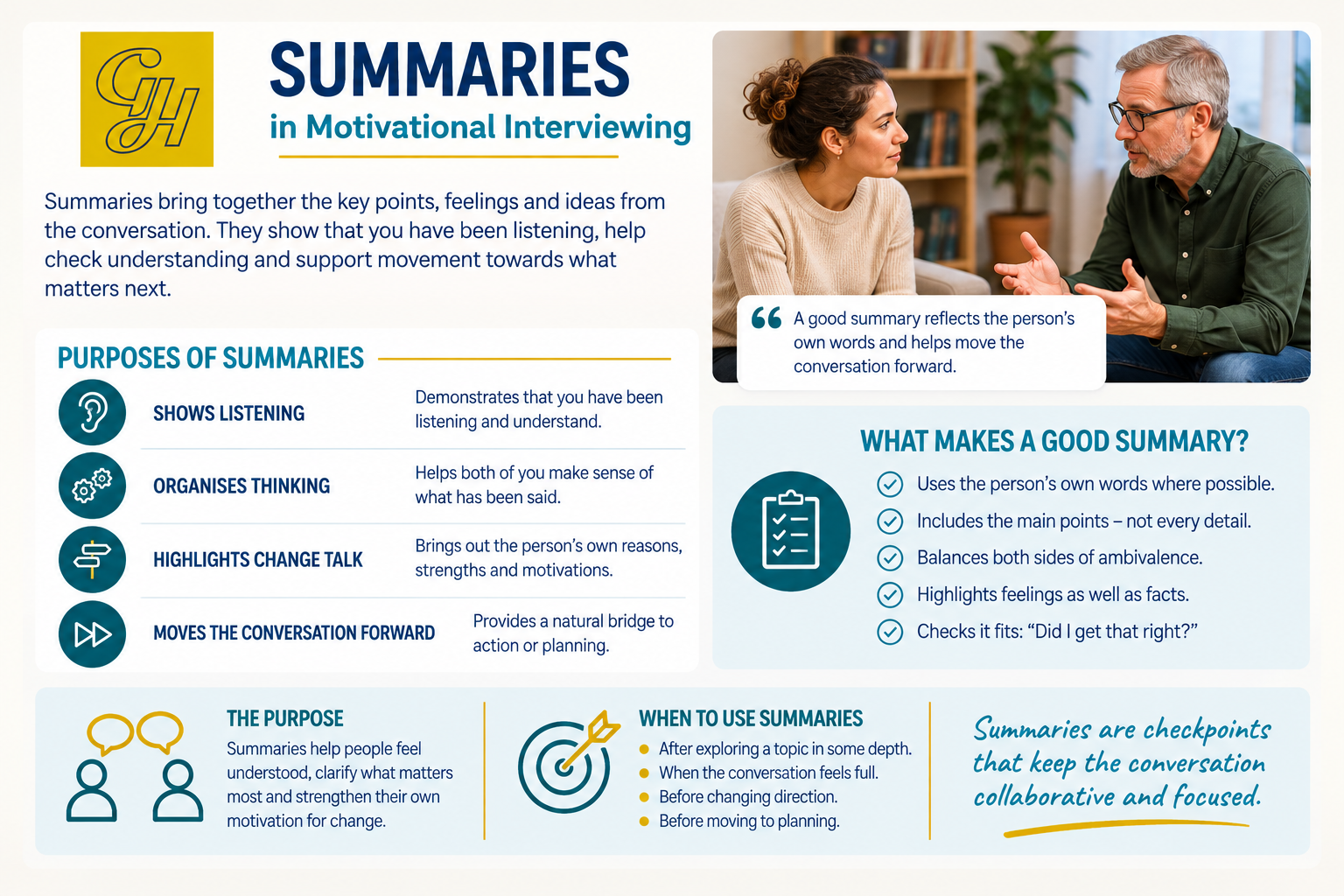
Summaries in Motivational Interviewing gather important parts of a conversation and offer them back in a way that can communicate understanding, highlight themes and help provide direction.
More than repeating everything
A useful summary is selective. It does not need to reproduce every detail. The practitioner listens for what seems important and brings relevant pieces together.
What can summaries do?
They can demonstrate listening, gather material after a period of exploration, link different parts of a conversation, highlight ambivalence, collect change talk and create a natural transition towards a new focus or planning.
SAMHSA’s guidance on Motivational Interviewing also describes summaries as a way of reinforcing what a person has said and linking material across a conversation.
Different purposes for summaries
Collecting summaries bring together material that has emerged over a period of conversation. Linking summaries connect something the person has just said with something they mentioned earlier. Transitional summaries help draw together what matters before moving towards a new focus or planning.
These are not rigid categories. The value lies in using a summary purposefully and in a way the person can still recognise as their experience.
Example: “On one hand drinking gives you a way to switch off after work, and that feels important. At the same time you’re increasingly worried about your sleep, your relationship and how much money it is costing. You’re not sure what you want to do yet, but you don’t want things carrying on exactly as they are.”
Direction without distortion
MI is directional, so summaries may sometimes give particular attention to language about change. That does not mean ignoring or misrepresenting sustain talk. A summary needs to remain recognisable to the person whose experience is being reflected.
When change talk has appeared at different points in a conversation, a summary can bring those pieces together without exaggerating them. The aim is to help the person hear their own motivations more clearly, not to make them sound more ready than they are.
Summaries and partnership
A summary is our understanding, not the final truth. Partnership means offering it tentatively and leaving room for the person to correct, add to or reshape it.
A simple “What have I missed?” or “How does that fit for you?” returns the conversation to the person and reinforces that the meaning belongs to them.
Continue exploring
OARS + I: Core MI Skills →
Reflective Listening →
Change Talk →
Return to MI Skills & Practice →
For further MI resources, visit the Motivational Interviewing Network of Trainers (MINT).
