
Understanding Motivational Interviewing
The History of Motivational Interviewing
The history of Motivational Interviewing begins in the early 1980s with the work of psychologist William R. Miller. MI developed from careful observation of conversations about alcohol use and from questions about why some ways of talking with people seemed to strengthen motivation for change while others increased resistance or defensiveness.
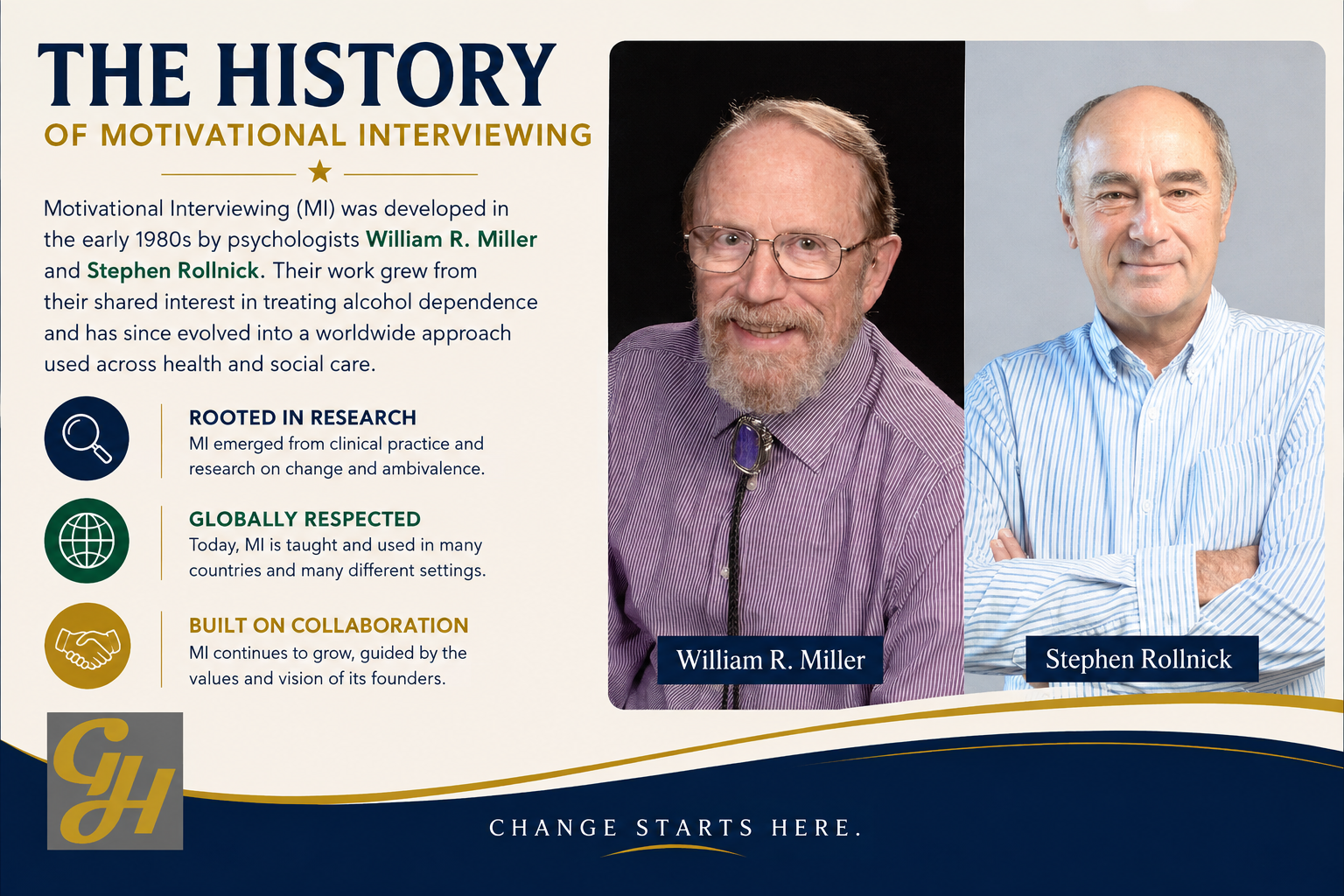
Over more than four decades, Motivational Interviewing has developed from an approach initially associated with alcohol treatment into a widely researched method of communication used across health, mental health, social care, criminal justice, education and many other settings.
Where did Motivational Interviewing begin?
William R. Miller first described the clinical approach that became Motivational Interviewing in a 1983 paper following work and discussions with colleagues in Norway. Rather than viewing motivation simply as something a person either possessed or lacked, the emerging approach paid close attention to how practitioner behaviour could influence conversations about change.
This shifted attention towards the interaction itself. Confrontation and persuasion could provoke arguments for not changing, while empathic listening and carefully exploring the person’s own reasons for change could support a different kind of conversation.
Miller and Rollnick

Emeritus Distinguished Professor of Psychology and Psychiatry, University of New Mexico

Honorary Distinguished Professor, School of Medicine, Cardiff University
Stephen Rollnick subsequently became central to the development of MI with Miller. Their collaboration helped refine the approach, extend its application beyond alcohol treatment and provide practitioners with a clearer framework for learning and using Motivational Interviewing.
The first edition of Motivational Interviewing: Preparing People to Change Addictive Behavior was published in 1991. Later editions reflected the continuing development of both the theory and practice of MI.
How Motivational Interviewing evolved
Early descriptions of MI placed considerable emphasis on principles such as expressing empathy, developing discrepancy, rolling with resistance and supporting self-efficacy. As research and practice developed, the language and conceptual framework also changed.
The third edition, published in 2013, described MI through four processes: Engaging, Focusing, Evoking and Planning. It also developed the understanding of change talk and sustain talk and gave greater attention to the relational and technical components of MI.
Explore the Four Tasks of Motivational Interviewing →
From processes to tasks
The fourth edition, published in 2023, continued the evolution of MI. The four processes became the four tasks of Engaging, Focusing, Evoking and Planning, emphasising that practitioners may move flexibly between them rather than progressing through a fixed sequence.
The fourth edition also updated the description of the Spirit of MI. Partnership, Acceptance, Compassion and Empowerment describe the underlying way of being with people that supports the practice of Motivational Interviewing.
Explore the Spirit of Motivational Interviewing →
The growth of Motivational Interviewing research
Since its beginnings, MI has been examined across a wide range of populations, behaviours and professional settings. Research has explored both whether MI is effective and how it may work, including the contribution of practitioner empathy, relational quality, change talk and fidelity to the method.
This research has also encouraged a more precise understanding of MI. Motivational Interviewing is not simply a collection of communication techniques. The way practitioners listen, respond, guide attention and support autonomy matters alongside the specific skills they use.
The Motivational Interviewing Network of Trainers
The Motivational Interviewing Network of Trainers, known as MINT, developed as an international community supporting high-quality MI training, practice and research. Its members have contributed to the spread and continuing development of Motivational Interviewing around the world.
For information and resources from the international MI community, visit the Motivational Interviewing Network of Trainers (MINT).
Motivational Interviewing today
Today, MI is used in settings far beyond its origins in addiction treatment. Practitioners use it in healthcare, mental health, social work, social care, criminal justice, education, coaching and organisational practice.
Despite this expansion, an important idea from the early development of MI remains central: conversations can influence motivation. How practitioners talk with people about change can either support thoughtful exploration and autonomy or inadvertently strengthen defensiveness and arguments against change.
